Quaid-e-Azam Muhammad Ali Jinnah’s Position on the Partition of India, Exchange of Populations, and Land/Property
The following statements and decisions of Quaid-e-Azam make it clear that the exchange of populations and land was not initially intended, but was a logical consequence of the circumstances.
The Pakistan that came into existence on 14 August was not the Pakistan that had originally been demanded or envisioned. This Pakistan was truncated, and its consequences depended less on deliberate planning and more on events. If Punjab and Bengal had not been partitioned, the large-scale massacres and migrations that occurred would also not have taken place.
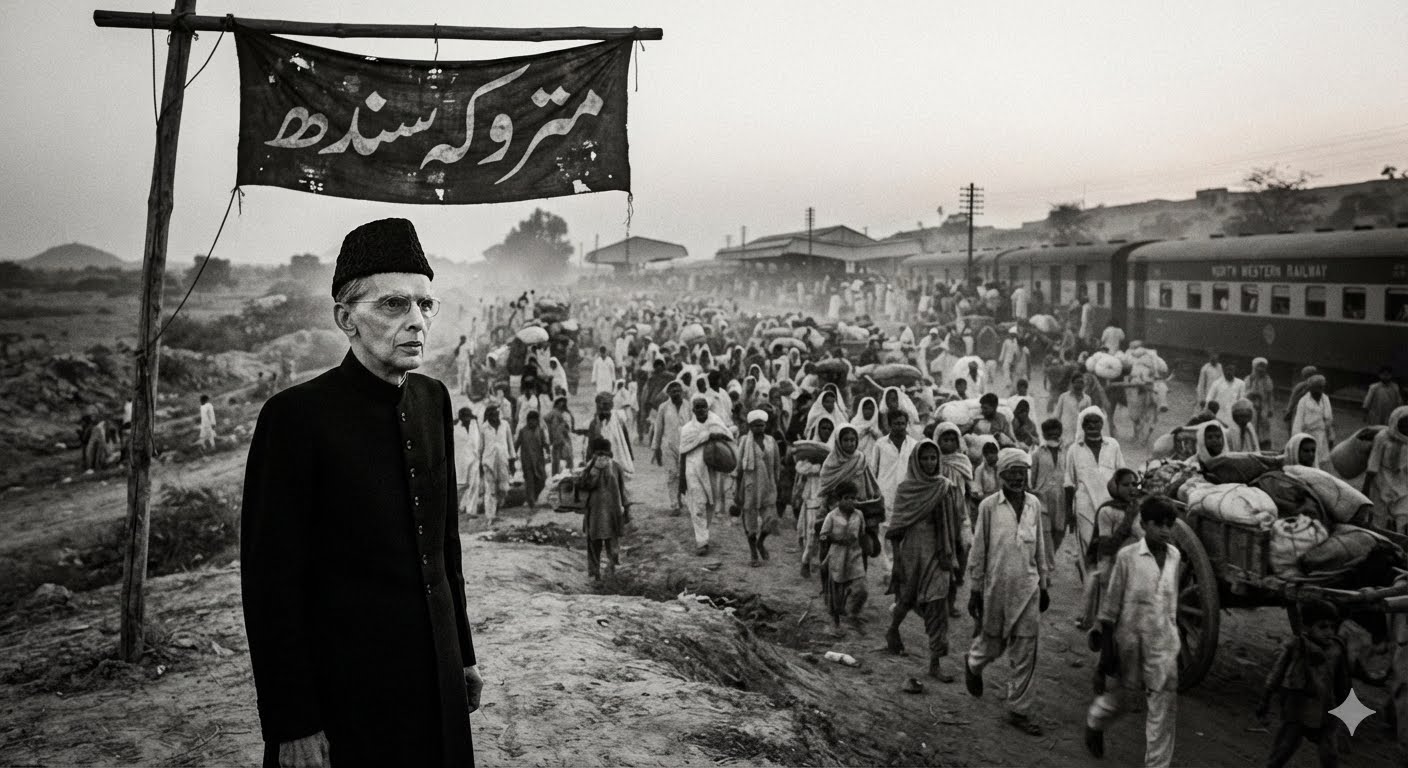
Initially, Quaid-e-Azam did not support a large-scale forced exchange of populations because the official position of both the Muslim League and the Congress was that minorities should remain in their homes and that their rights should be protected.
His position changed after the communal riots of 1946, particularly the massacre of Muslims in Bihar.
A statement by Quaid-e-Azam, published by the IB Department and still available today in the UK National Archives, states that the All-India Muslim League’s demand was not for the partition of Punjab and Bengal; if partition took place, there would be massacres, and consequently there would also be an exchange of populations and land:
https://www.nationalarchives.gov.uk/wp-content/uploads/2014/03/fo371-635331.jpg
Most Famous Statement: 11 September 1946
(Statement issued from Bombay)
“In view of the terrible massacres taking place in various parts of India, I am of the opinion that the Central and Provincial authorities should immediately consider the question of exchange of populations in order to avoid a brutal repetition of what has happened in those areas where small minorities have been massacred by the majority.”
Other Statements
November 1946: Following the Bihar tragedy: “The exchange of populations will have to be considered seriously.”
April 1947: “Sooner or later an exchange of population will have to take place. The two States will carry it out wherever necessary and feasible.”
Position on Land and Property
Quaid-e-Azam wanted the whole of Punjab and Bengal to remain part of Pakistan. He regarded the partition of Punjab and Bengal as creating a Pakistan that was “moth-eaten.”
After the Radcliffe Award was announced, he described it as unjust, incomprehensible, and misleading, but accepted it because of the commitments that had already been made.
After partition, the issue of evacuee land became a major problem.
Initially, Quaid-e-Azam urged minorities to remain in their homes, but after the riots he proposed a voluntary exchange of populations. With regard to land, he wanted Muslim-majority areas to remain entirely within Pakistan and continued to guarantee the protection of the property of minorities. The destruction that occurred after partition was different from his original conception.
Reference: November 1946 Statement
Original words:
“The exchange of populations will have to be considered seriously as far as possible, especially after this Bihar tragedy.”
Urdu translation:
“The exchange of populations will have to be seriously considered as far as possible, especially after this Bihar tragedy.”
This statement was made in Delhi on 14 November 1946 (it was published in some newspapers on 15 November).
It appears in the Jinnah Papers (Quaid-i-Azam Papers Project), Volume 14: League-Congress Deadlock (1 August 1946 – 19 February 1947).
The Dawn newspaper published it on 15 November 1946.
In addition, at a press conference in Karachi on 25 November 1946, Quaid-e-Azam made a statement of a similar nature, saying that the authorities should immediately consider the question of an exchange of populations.
April 1947 Statement
Original words, with the full context:
“It is obvious that if the Hindu minorities in Pakistan wish to emigrate and go to their homelands of Hindustan, they will be at liberty to do so and, vice versa, those Muslims who wish to emigrate from Hindustan can do so and go to Pakistan; and sooner or later an exchange of population will have to take place, and the Constituent Assemblies of Pakistan and Hindustan can take up the matter and subsequently the respective Governments in Pakistan and Hindustan can effectively carry out the exchange of population wherever it may be necessary and feasible.”
Urdu translation:
“Sooner or later an exchange of populations will have to take place, and the Constituent Assemblies of Pakistan and Hindustan can consider the matter. Subsequently, the respective governments can effectively carry out the exchange of populations wherever it may be necessary and feasible.”
Reference
This statement was issued on 30 April 1947.
It appears in the Jinnah Papers, Series 1, Volume 1: Prelude to Pakistan (20 February – 2 June 1947), pages 681–682.
It is also included in Mehrunnisa Ali (ed.), Jinnah on World Affairs: Select Documents, 1908–1948 (Pakistan Study Centre, University of Karachi, 2007), p. 372.
Both statements are preserved in the official publications of the Quaid-i-Azam Papers Project (National Archives of Pakistan), and are therefore regarded as authentic.
Sindh Land Alienation Bill, 1947
The Sindh Assembly passed this bill, allegedly on discriminatory grounds, a few days before the establishment of Pakistan. However, because of the partition of the subcontinent and the transfer of power, the bill did not acquire legal force.
Delay by the Viceroy
After being passed by the Assembly, the bill was sent to the Viceroy of India, Lord Mountbatten, for final royal assent. Since the partition of India was imminent, Mountbatten delayed signing it and left the final decision to the incoming government.
Quaid-e-Azam’s Veto
After the establishment of Pakistan, the bill was presented to Quaid-e-Azam Muhammad Ali Jinnah in his capacity as Governor-General. On the advice of Prime Minister Liaquat Ali Khan and his cabinet, Quaid-e-Azam Muhammad Ali Jinnah refused to sign the bill, effectively vetoing it.
Reason for Cancellation
Instead of returning the lands to the local Sindhis, the government of the newly established country prioritized the settlement of the millions of Muslim refugees who had migrated from India. The government’s position was that the lands left behind by Hindus should be placed in the pool of “Evacuee Property” so that they could be used for settlement.
Dr Nadeem Rizvi
MatrukaSindh Tehreek