
The relationship between Quaid-e-Azam Muhammad Ali Jinnah and Prime Minister Liaquat Ali Khan was pivotal in shaping the political trajectory of the All India Muslim League and ultimately the creation of Pakistan. After the Round Table Conference (1930), Jinnah had withdrawn from Indian politics and relocated to London to practice law, but at the urging of Liaquat Ali Khan, he returned to lead the Muslim League in 1934, revitalizing the party and its demand for Muslim political safeguards (Wolpert, 1984). In his final days, Jinnah was accompanied only by Fatima Jinnah and Liaquat Ali Khan, and he expressed deep concern for the unresolved status of Kashmir, the urgent need for a constitution, and the rights of the Muhajir community (Fatima Jinnah, 1987). Some oral histories attribute to Jinnah a deathbed remark describing the creation of Pakistan as a “horrific mistake,” Scholars such as Wolpert (1984) and Hayat (2008) suggest that Jinnah’s late-life anxieties reflected frustration with the chaotic and violent process of Partition rather than regret over Pakistan’s existence. Consequently, these alleged remarks should be interpreted cautiously and situated within the context of Jinnah’s documented commitment to building a constitutional and inclusive Pakistani state while extremely upset with Sinhi hatred towards Muhajir.
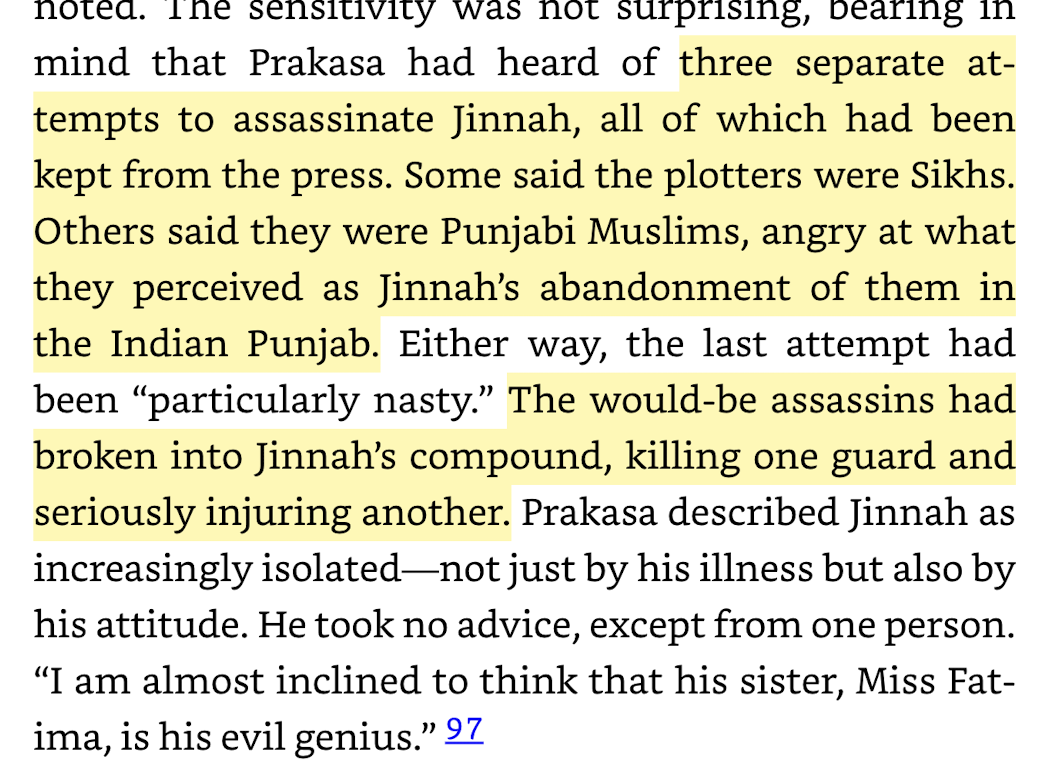
Quaid-e-Azam’s statement that “the creation of Pakistan was their horrific mistake” had no other cause except for the treachery and betrayal of the Sindhi landlords (waderas), who, before the creation of Pakistan, used to call themselves Muslim nationalists. Their sudden change of loyalty was solely because of the arrival of the Muhajirs (refugees) in Sindh. Until December 1947, there were three assassination attempts on Quaid-e-Azam that were kept secret from the public. This book attempts to place suspicion for those attacks on Sikhs and Punjabi Muhajirs, but that is, in fact, the conspiratorial mindset of India, which had been linked with Sindh’s landlords from day one.
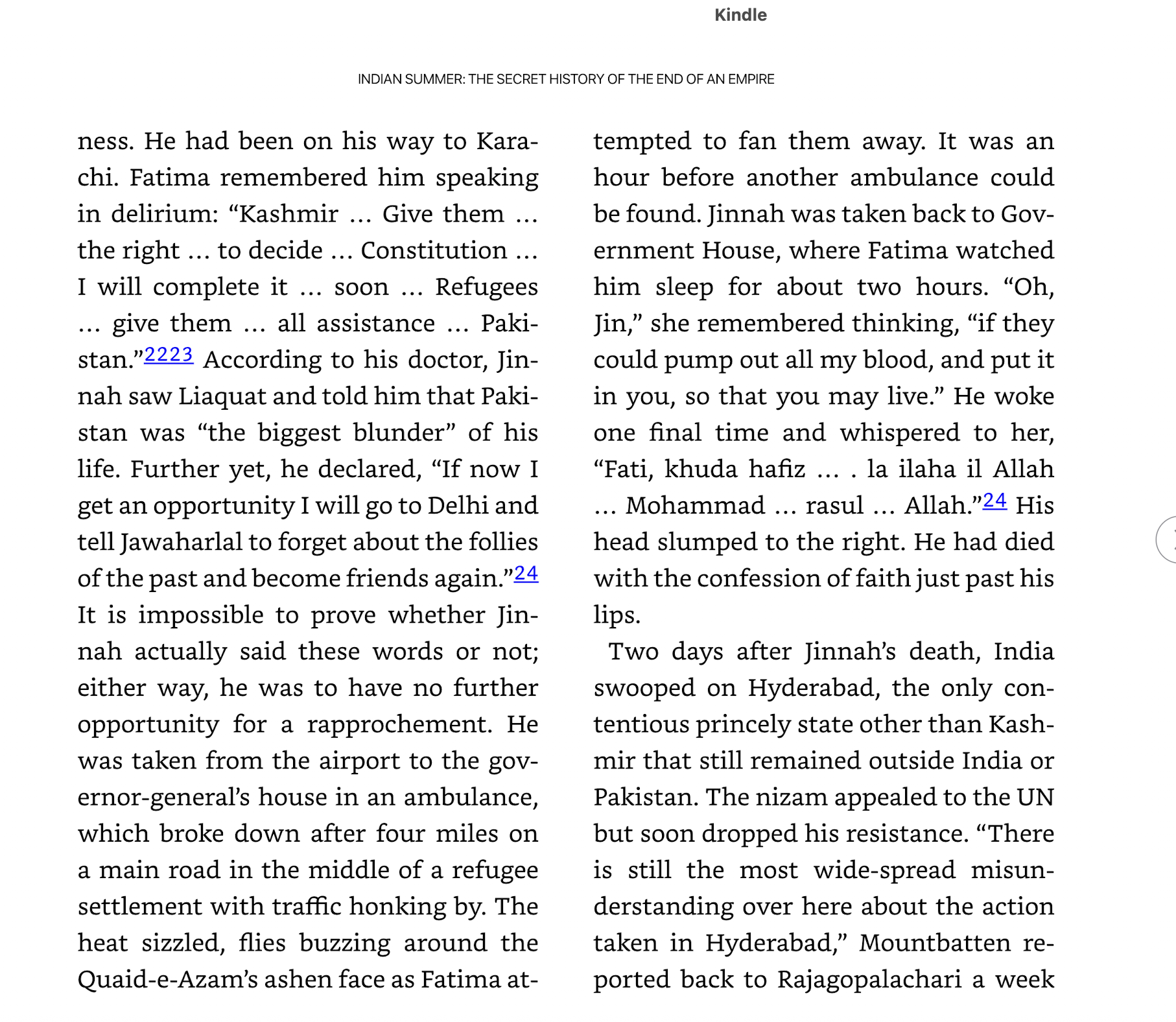
I believe that, given the circumstances, it is entirely possible that these assassination attempts were carried out by the Sindhi landlords themselves. In fact, when Quaid-e-Azam came to Karachi from Quetta on the day of his death, the provincial Health Minister under Ayub Khuhro conspired to send a government ambulance to the airport with no fuel in it. It was Liaquat Ali Khan who immediately sent a second ambulance. Quaid chose not to go to the hospital but rather to the Governor-General’s House, as he had realized his final moments had arrived.
We all know that Quaid was suffering from incurable tuberculosis, but this fact had been kept hidden for political reasons. As early as 1946 — even before the creation of Pakistan — Sindh’s leader G. M. Syed had clashed bitterly with Quaid-e-Azam over election tickets. This was the same G. M. Syed who had once invited Muslims of India to settle in Sindh and take up the reins of life there, but after the riots, he became extremely enraged at the arrival of Muhajirs in Karachi and Sindh. He was not alone — every member of the Sindh Assembly had, in that moment of suffering for the Muhajirs, become worse than the worst enemy of India.
From January 1948 onward, Muhajirs were looted at various places, expelled from evacuee lands, dragged out of allotted houses by Khuhro’s government and thrown into jails, and entire trainloads of Muhajirs were forcibly pushed back to India in inhumane operations. All of this left Quaid deeply distressed, making him feel that Hindus in India were better than the Sindhis. The delays in resolving the Kashmir dispute and in framing the constitution also troubled him greatly. Looking at the events of his last day and the terrorism faced by Muhajirs in Sindh, one can quite easily say that those responsible for the assassination attempts on Quaid-e-Azam — and perhaps even for his death — were the same enraged Sindhi politicians who had earlier been involved in the murder of Allah Bakhsh Soomro.
References:
- Fatima Jinnah. (1987). My Brother. Karachi: Quaid-i-Azam Academy.
- Hayat, S. (2008). The Charismatic Leader: Quaid-i-Azam Mohammad Ali Jinnah and the Creation of Pakistan.Karachi: Oxford University Press.
- Jalal, A. (1994). The Sole Spokesman: Jinnah, the Muslim League, and the Demand for Pakistan. Cambridge: Cambridge University Press.
- Wolpert, S. (1984). Jinnah of Pakistan. New York: Oxford University Press.