Who Is the “Priest-King”?
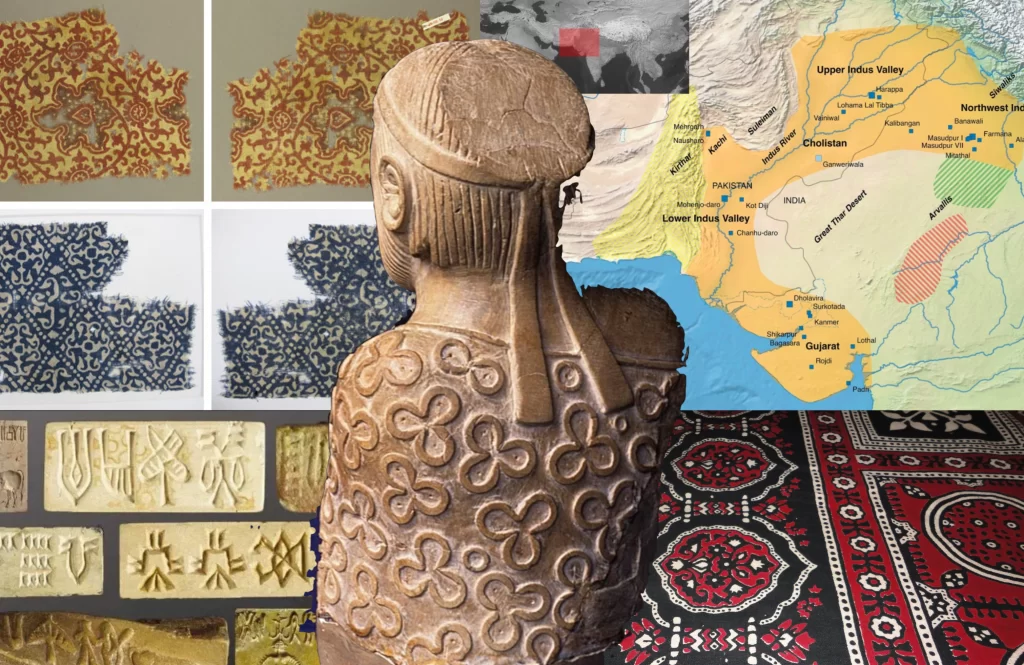
The so-called “Priest‑King” is a small, intricately carved steatite (soapstone) bust unearthed during excavations at **Mohenjo‑daro**, a principal city of the **Indus Valley Civilization (IVC)**, around **2000–1900 BCE**. It is among the most iconic representations of the IVC, embodying its artistic refinement and enigmatic social hierarchy ([Priest-King]. It’s very important to understand that current province of Sindh, Pakistan doesn’t mean Sindh civilization nor the people currently boasting themselves as indigenous people of Sindh have anything to do with five thousand years old IVC. Mohenjo-daro was the part of the civilization comprised of vast region of current Pakistan and India. We will discuss the geographical extent of IVC in some other article . Our focus in this article is limited only to the priest bust and his cloak.

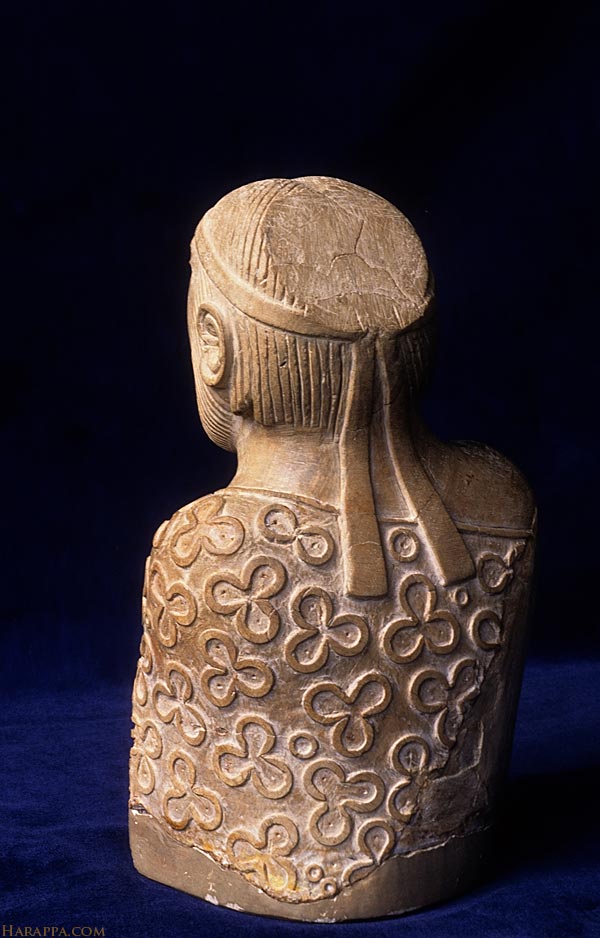
The figure exhibits a neatly groomed beard, a head fillet—suggesting a headdress or stylized hair—and a finely decorated cloak bearing drilled motifs such as trefoils, single circles, and double circles filled with red pigment ([Priest-King].
The label “Priest‑King” emerged from early excavators—Ernest J. H. Mackay initially considered it might depict a “priest,” while Sir John Marshall termed it possibly a “king‑priest.” The designation was later popularized by Mortimer Wheeler. Nonetheless, modern scholars regard this title as speculative and “without foundation” ([Wikipedia].
Identifying Him as “Sindhi” Is Anachronistic
The IVC flourished between approximately 2600–1900 BCE in a vast region that spans modern-day Pakistan, northwestern India, and beyond—but well before the concept of “Sindhis” as a modern ethnolinguistic group ever existed ([Indus Valley Civilisation ]
Modern Ethnic Labels Don’t Apply
The term “Sindhi” refers to speakers of the Sindhi language and identity shaped over last few centuries especially after the formation of nation-states. Applying such a label to an IVC figure effectively imposes a modern identity onto a prehistoric subject, which is historically inaccurate. I am an anesthesiologist by profession and it’s not easy to dive into archeological literature, however I am compelled to correct the false narrative generated by hateful minds of Sindh. Before going deeper into the detail of the so called “Priest King and Ajrak”, let’s understand with the help of reliable sources that current Sindh language is not what racist or so called Sindhi nationalists try to portray.
1. The Sindhi language we know today is not a survival of the Indus Valley tongue. It is part of the Indo-Aryan branch of the Indo-European family, and it developed thousands of years after the fall of Mohenjo-daro and Harappa. Here’s a detailed breakdown. Sindhi belongs to the North-Western Indo-Aryan subgroup, along with Punjabi, Lahnda, Gujarati, and Rajasthani. It descends from Middle Indo-Aryan languages (Prakrits and Apabhraṃśa), which themselves evolved from Old Indo-Aryan (Sanskrit, c. 1500–500 BCE). Linguists trace Sindhi’s emergence as a distinct language to around the 8th–10th centuries CE, when regional dialects of Apabhraṃśa in Sindh crystallized into early Sindhi. Reference: Masica, Colin P. The Indo-Aryan Languages. Cambridge University Press, 1991.
2. Influences on Sindhi
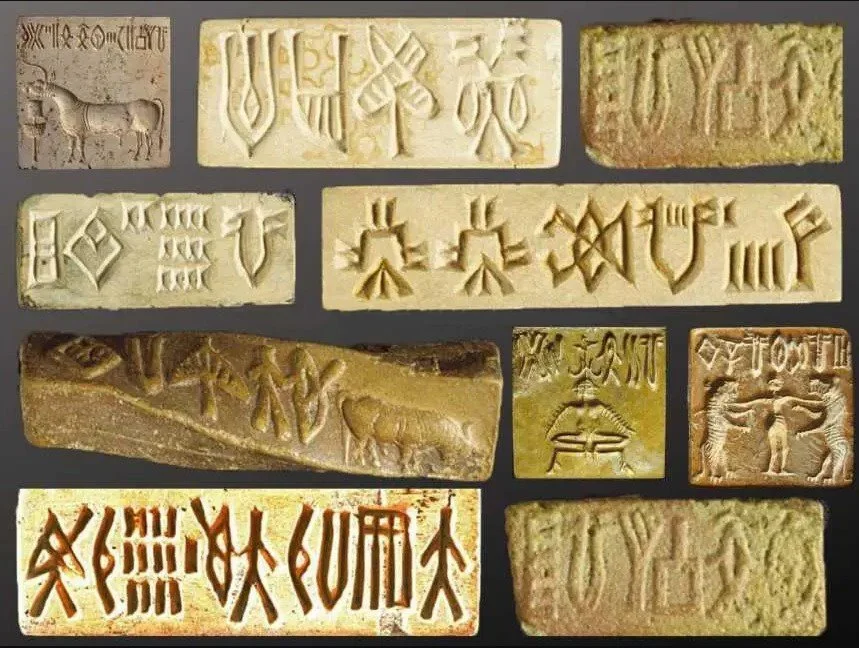
- Indus Valley languages: The Harappan script (2600–1900 BCE) remains undeciphered. No direct evidence links it to Sindhi, though Sindh is geographically the same region.
- Iranian influence: Proximity to Persia meant early Sindhi absorbed Persian and Arabic vocabulary, especially after the Umayyad conquest of Sindh (711 CE).
- Sanskrit & Prakrit base: Sindhi grammar, phonology, and much of its lexicon descend from Indo-Aryan sources.
- Later layers: Arabic, Persian, and even Turkish loanwords entered through centuries of Islamic rule, enriching Sindhi’s vocabulary.
Reference: Shackle, Christopher. Sindhi. Routledge, 1976.
No Evidence of so called “Preist-King” Individual Identity
Scholars point out that the IVC left no inscriptions identifying individuals, including the “Priest‑King.” All labels—priest, king, Sindhi—are speculative and lack supporting evidence ([Religion of the Indus Valley Civilisation] [ResearchGate]
Significance of the Bust: Despite the uncertainty, the “Priest‑King” remains hugely significant:
Artistic Mastery, The figure exemplifies the Indus civilization’s sophisticated approach to portraiture and iconography: naturalistic detail balanced with stylized abstraction.
Social Hierarchy & Symbolism: Although no definitive ruling class or priesthood has been confirmed archaeologically, the figure’s regalia—especially the patterned cloak and headband—suggests ritual or elite authority. However, interpretations vary, and recent scholarship emphasizes that the IVC may have been “more egalitarian” than previously assumed.
Cultural Interconnections: Art-historical comparisons highlight affinities with Mesopotamian art in facial stylization, suggesting possible cultural exchanges. Yet, these remain hypotheses, not conclusive evidence.
The “Priest-King” must be understood as an IVC elite figure of unknown identity and function—“not” a “Sindhi” in the contemporary ethnic or cultural sense. Modern labels of “Sindhi” should not be retroactively applied to ancient contexts, lest we impose false identities on a civilization that left no record of them. Same goes to Ajrak. Let’s delve into the cloak.
The Mohenjo-daro “Priest-King” is shown wearing a *stone-carved cloak with trefoil and circular motifs, not a block-printed textile. No archaeological source identifies it as ajrak, and the technology and surviving examples of Indian block-printed cloth (the class ajrak belongs to) are documented millennia later.
What the sculpture actually shows
Museum and archaeology descriptions state the figure’s “left shoulder is covered with a cloak decorated with trefoil, single-circle and double-circle designs; the motifs were “carved” and originally “filled with red pigment”—they are not printed fabric. ([Harappa].
Art-historical overviews likewise describe “raised trefoils and circles carved in shallow relief” on the garment, again with no claim that it is ajrak. ([Smart History], [MAP Academy]
About ajrak and block-printing
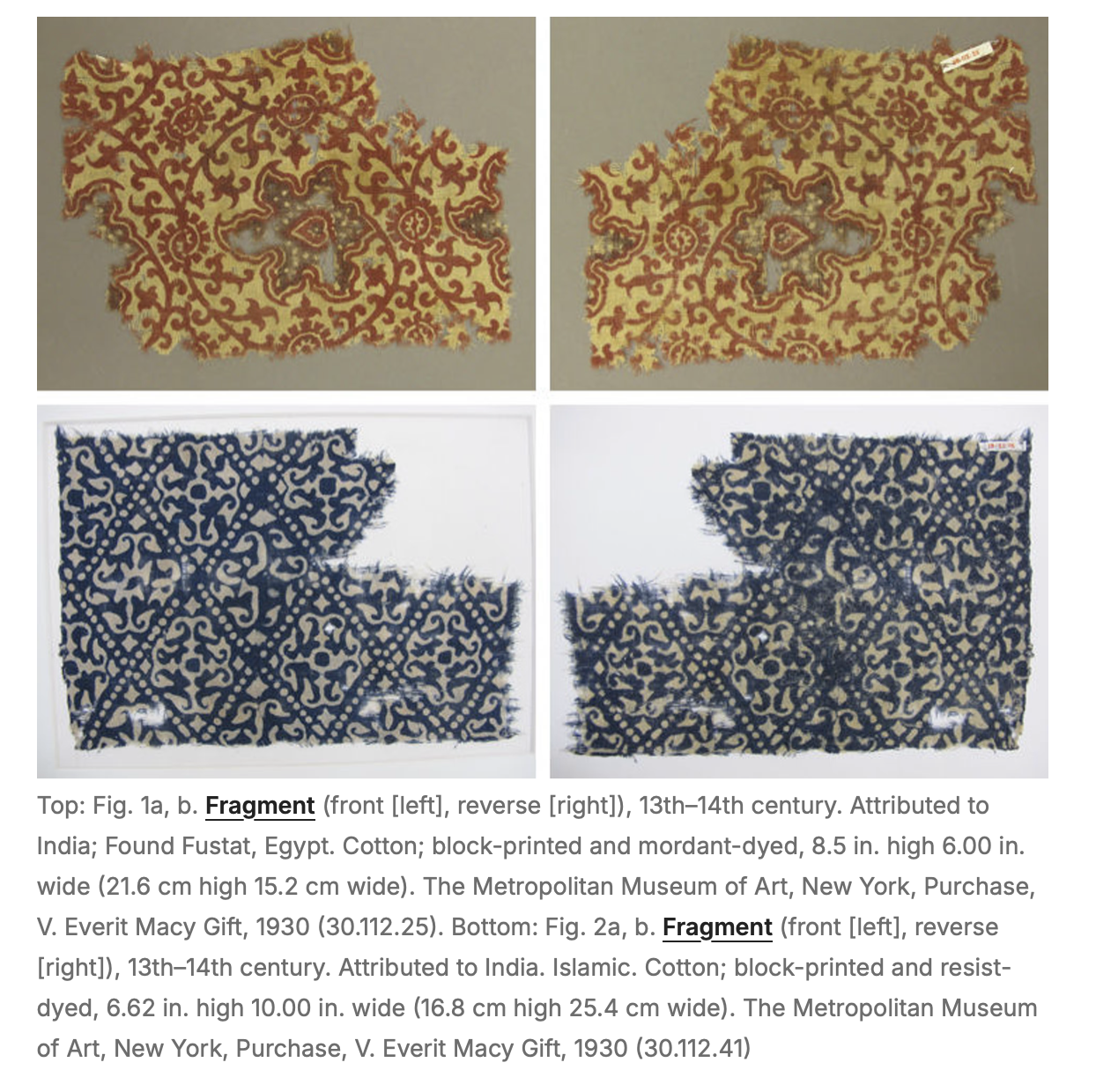
Ajrak is a block-printed cotton tradition (typically indigo/madder) from Kutch. The earliest securely dated, excavated Indian block-printed textiles known today came from Egypt (Fustat/Quseir al-Qadim) and are from Mamluk-period,c. 13th–14th century CE. Over two thousand years after the Indus bust. [The Metropolitan Museum of Art]. Pattern and designs of these earliest excavated Ajrak are quite close to the current Ajrak being printed in Ajrakh Gujrat or even in Province of Sindh.
The shawl or cloak of the so-called “Priest-King” is decorated with trefoil and circular (single and double) motifs that are carved and inlaid with pigment, not printed. Archaeological reports note that the designs were originally filled with red paste to enhance their visibility (Kenoyer, 1998; British Museum, Mohenjo-daro Collection). This differs fundamentally from Ajrak, a much later textile tradition from Sindh and Kutch that relies on block-printing techniques. Ajrak is typically produced in deep indigo and madder red, characterized by geometric motifs such as stars, floral rosettes, and checkered grids, arranged in symmetrical mirror-image or radial patterns (Shackle, 1976; The Textile Society of America, 2012). Trefoils, however, are not a feature of block-printed design and are scarcely conceivable within that medium. What we observe on the cloak of the Priest-King bust is therefore not a patterned textile, but more likely evidence of early embroidery or appliqué work, as the trefoil motifs appear raised from the surface (Marshall, 1931; Mackay, 1938).
As our analysis confirms, the design of the Priest-King’s cloak is not comparable to Ajrak. The only superficial similarity lies in the presence of red pigment. The traces of red discovered on the cloak provide us with early evidence for the use of dye derived from the madder plant—but nothing more, and certainly nothing to do with Ajrak.
This raises important questions. Where did this pigment originate? Was it produced locally in the region of Mohenjo-daro, or could the cloak have been made elsewhere and traded into the city? Historical research shows that natural red dyes could be extracted from several plants:
- Indian mulberry (Morinda citrifolia L.),
- Indian madder or munjeet (Rubia cordifolia),
- Chay root (Oldenlandia umbellata L.).
These dye plants are native to South India, Southeast India, and the Himalayan region, and each is chemically distinct from the more familiar dyer’s madder (Rubia tinctorum L.), which originated in the Middle East and Europe. Analysis of dye composition on historic textiles is therefore crucial in determining historical and geographic provenance. Significantly, none of these red-dye plants are known to grow naturally in the southern Indus valley, corresponding to today’s Sindh province in Pakistan (Metropolitan Museum of Art).
Another decisive distinction is that Ajrak textiles incorporate indigo (blue/black) dyeing, which has never been found on artifacts from Mohenjo-daro.
Taken together, this evidence strongly indicates that Ajrak, in any form, has no historical or cultural connection to the cloak of the Priest-King.
Ajrak as a block-printed textile tradition appears much later, between the 8th and 10th centuries CE, whereas the Indus Valley Civilization flourished over two millennia earlier (c. 2600–1900 BCE). This chronological gap further confirms that the cloak cannot be identified as Ajrak.
Nadeem Rizvi MD
@MatrukaSindh