An examination of ethnicity, language, the Indus name, history, and political reality
Sindhi is a geographic and administrative label, not a nation. A nation, in the political sense used by
nationalists, is a people who share a common political destiny, a defined territory they claim as theirs alone, and usually either an existing sovereign state or a credible, widely supported claim to one. The people now called Sindhi are not a single historic stock, not a single language community, and not the exclusive heirs of a name that once described a river system far larger than today’s province. Distinct language, literature, and regional culture exist. That does not make “Sindhi” a nation in the same category as Pakistan, Iran, or Bangladesh.
What “nation” actually requires
Political theorists distinguish ethnicity from nationhood. An ethnic group shares language, ancestry
narratives, customs, or religion. A nation is that group mobilized around political self-rule or already
organized as a state with recognized borders and government. Nationality, in legal usage, is citizenship of a state.
The population of Sindh meets none of those tests as a single people. Most residents hold Pakistani
nationality. There is no independent Sindhi state, no internationally recognized Sindhi government, and no mass movement that has converted regional pride into a successful bid for sovereignty. 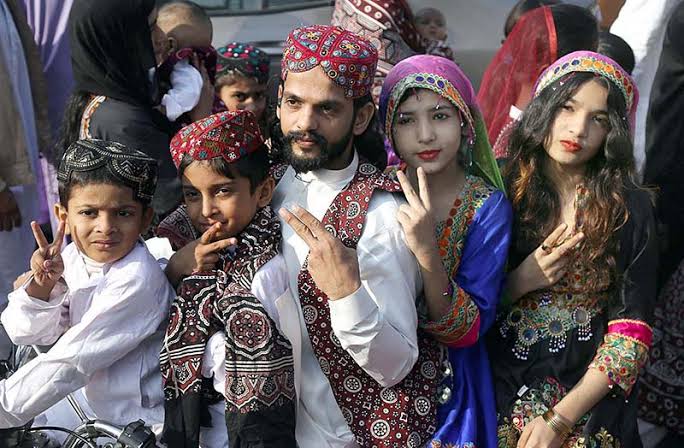
The name comes from a river, not from one province
“Sindh” is not originally the name of a nation. It is the name of a river. Sanskrit Sindhu means river or
stream and, by extension, the Indus. Old Persian turned the initial s into h, producing Hindu / Hindush for
the Indus country. Greek speakers dropped the initial h and produced Indos and India. The English word
India is therefore a later form of the same river-name. The label first meant “the land of the Indus,” then, in Persian and Greek usage, the wider country beyond the river.
That river system is not confined to the modern Pakistani province of Sindh. The Indus rises in Tibet,
runs through Ladakh and Gilgit-Baltistan, receives the Kabul River and the five rivers of the Punjab, and
only then crosses the alluvial plain now called Sindh. Achaemenid inscriptions list Hindush as a satrapy of the lower Indus; Vedic Sapta Sindhavah (“seven rivers”) pointed to the Punjab drainage. Arab geographers later split al-Sind from al-Hind, but even that “Sind” was a caliphate province, not a nation-state. To treat the modern provincial boundary as the historic homeland of a people named after the entire river is to shrink a continental hydrology into one administrative unit.
People living along the lower Indus were therefore called Sindhi in the same way people living along the
Nile were called Egyptians: by the river, not by a sealed ethnic nation. The name travelled farther than the
present province. It cannot be used as proof that one language group in one province is a nation.
Not a single language and not a homogeneous people
The claim that “Sindhis” are one historic linguistic nation collapses on the ground. Even what is
officially counted as Sindhi is a dialect continuum, not a uniform speech: Vicholi (the literary standard
around Hyderabad), Lari in the south (Thatta, Badin, coastal tracts), Uttaradi in the north, Lasi in Lasbela
and adjoining country, Siroli overlapping Saraiki in the far north, plus Kutchi and Jadgali across the old
Sindh–Kutch–Makran belt. These varieties differ in phonology, vocabulary, and pronouns. Treating them as one sealed language is a modern standardizing project, not an ancient fact.
Large settled communities inside the province do not speak Sindhi as a mother tongue at all. The 2023
census recorded about 33.5 million Sindhi speakers in a provincial population of 55.7 million—alongside
more than 12 million Urdu speakers, nearly 3 million Pashto speakers, 2.3 million Punjabi speakers, 1.2
million Balochi speakers, about 913,000 Saraiki speakers, and some 266,000 Brahui speakers, plus hundreds of thousands listed under other languages. Karachi, the capital and economic core, is majority
Urdu-speaking; Sindhi speakers are a minority there.
Two cases make the point sharper. Thari / Dhatki, spoken by on the order of 1.8 million people in
Tharparkar and Umerkot and across the border in Barmer and Jaisalmer, belongs to the Western Rajasthani group (close to Marwari), not to standard Sindhi. It shares some sounds with Sindhi through contact, but linguists class it with Rajasthani. Desert social structure, caste map, and ritual life differ from the irrigated canal tracts. Brahui is a Northern Dravidian language—genetically unrelated to Sindhi, Balochi, or Urdu.
Brahui speakers live in a belt from Kalat into Jacobabad, Larkana, Nawabshah, Hyderabad, and Karachi.
Their language and tribal organization are not “Sindhi with a different accent.”
Baloch tribes have lived in Sindh for centuries. Many now speak Sindhi; others speak Balochi or Saraiki.
The last independent rulers of Sindh before the British, the Talpurs, were a Baloch lineage that had adopted Sindhi speech. Estimates in the late twentieth century put people of Baloch tribal origin in Sindh in themillions. They are part of the provincial population. They are not evidence of one primordial Sindhi race.
Add the older Sammat groupings, Hindu communities (Lohana, Bhaiband, scheduled-caste groups
concentrated in Thar and lower Sindh—Hindus are about 8.8 percent of the province), Sheedi and Makrani populations on the coast, and post-1947 Urdu-speaking migrants, and the picture is a stacked settlement history, not a single historic nation. “Sindhi” here functions the way “Punjabi” or “Bengali” often does: as a regional umbrella that covers several languages, several tribal origins, and several religious communities.
History does not show a continuous Sindhi nation-state
Sindh has had periods of local rule: Rai and Chach dynasties before the Arab conquest, later Soomra,
Samma, Kalhora, and Talpur houses. Those episodes matter for regional history. They do not add up to a
continuous nation.
For most of the last 2,300 years the territory was a province, satrapy, or vassal of larger powers:
Achaemenid Persia, Mauryan India, the Umayyad and Abbasid caliphates (which made it al-Sind), the Delhi Sultanate, the Mughal Empire (Subah of Thatta), then brief autonomy under the Kalhoras and Talpurs before British annexation in 1843. After 1843 it was part of the Bombay Presidency until it became a separate British Indian province in 1936. In 1943 the Sindh Assembly—on a resolution moved by G.M. Syed—was the first provincial legislature to endorse the Pakistan demand. Pakistan for ten crore Muslims of India not just of Sindh. In 1947 it entered the new Dominion of Pakistan. Khairpur’s Talpur ruler acceded the same year.
Local dynasties existed. They were repeatedly subordinated to, or absorbed by, larger imperial systems.
That pattern is common across South Asia. It is not evidence of a pre-existing nation that was later “denied”
statehood.
Separatist nationalism has remained a minority current
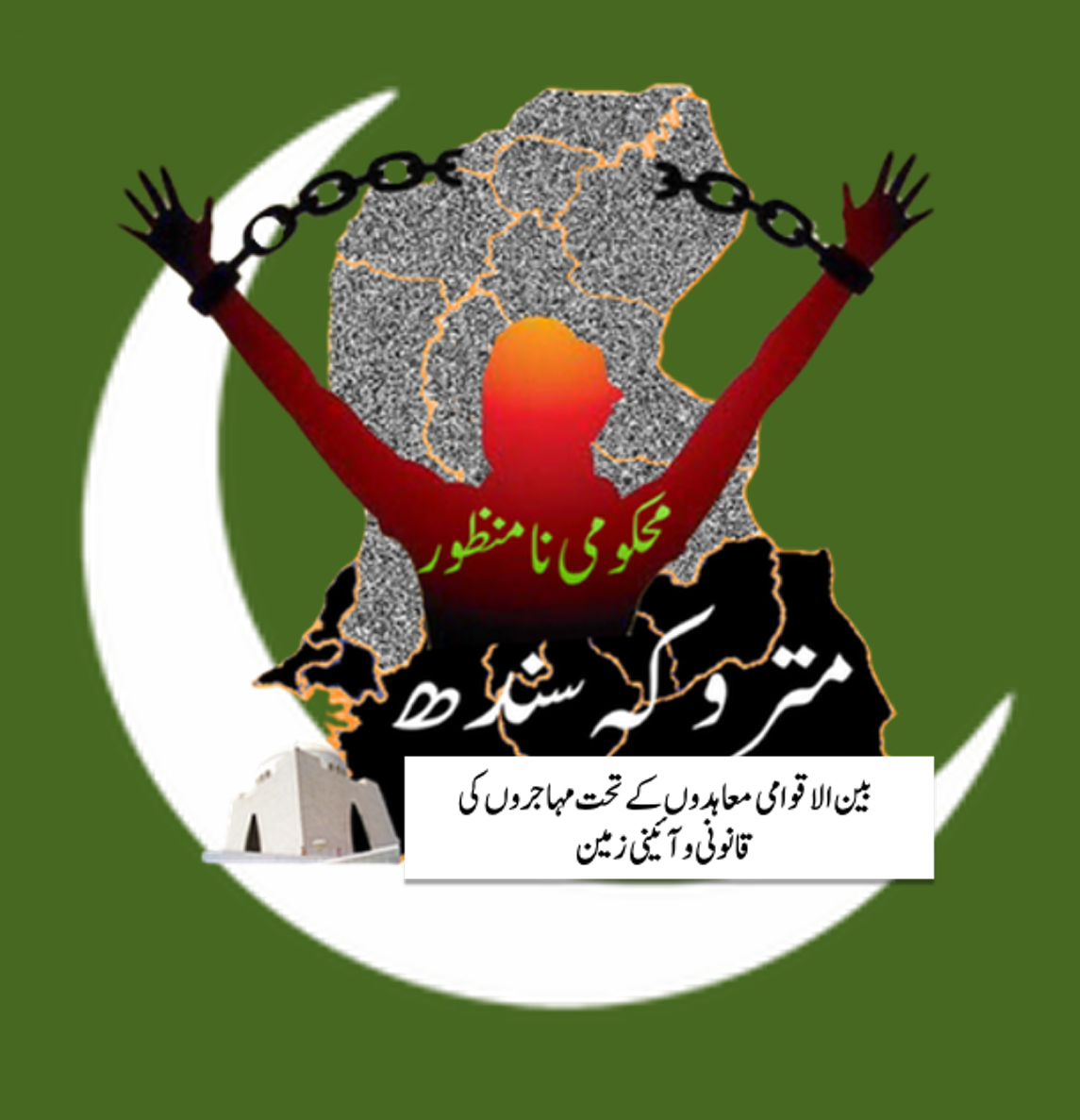
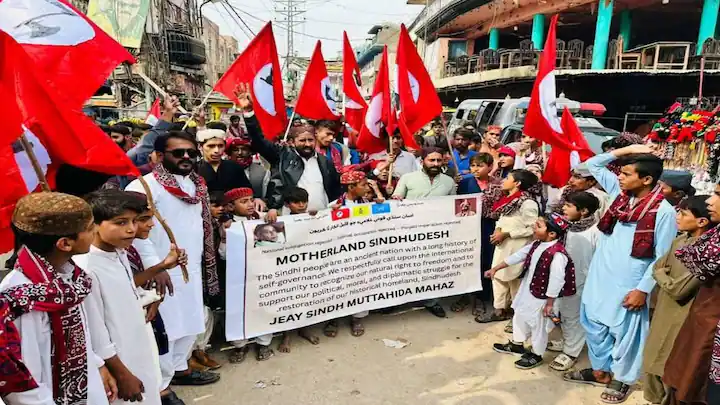
Modern Sindhi nationalism as a separatist idea is associated with G.M. Syed after 1971. Inspired by
Bangladesh, he founded Jeay Sindh Mahaz and later wrote that Pakistan should disintegrate so that
“Sindhudesh” could emerge. The movement split into many factions; some turned to low-level violence. It has never won a provincial election or built a durable mass following comparable to the Pakistan Peoples Party, which has dominated Sindh politics for decades while remaining a federal Pakistani party.
A 2009 Pew survey found 55 percent of Sindhis identified first as Pakistani, 28 percent first as Sindhi,
and 16 percent as both equally. That is the opposite of the profile of a people who regard themselves as a
captive nation. Cultural assertion—language, Shah Abdul Latif, Sufi shrines, opposition to certain federal
water or administrative projects—is real. Converting it into a claim that “Sindhi” is a nation equivalent to
“Pakistani” has not succeeded with most residents of the province themselves.
Culture does not automatically create a nation
Sindhi literature and the Sufi tradition of the lower Indus are sources of legitimate pride. So are
Mohenjo-daro, Makli, and the long Islamic history of the region as Bab-ul-Islam. None of these facts require a separate state, and none erase the other languages and peoples who share the same land. Shared
civilization, overlapping religious practice, and centuries of rule from Delhi, Thatta, or Karachi under larger polities cut the other way: they show integration into broader South Asian and Islamic worlds rather than isolation as a self-contained nation.
Pakistan was founded on the two-nation theory as a state for Muslims of the subcontinent, not as a
federation of pre-existing ethnic nations that happened to be Muslim. Sindh’s own political class in the
1940s participated in that project. Later grievances about resources, representation, or language policy are
provincial and federal issues. They do not rewrite the category of the people who live there.
Calling every distinct language group a “nation” empties the word of meaning. In this case the premise is
weaker still: the group is not even one language, not one historic stock, and not the sole owner of a name
that once marked the Indus and, through Persian and Greek, the whole land called India. The historical
record, the census, voting patterns, and the absence of a functioning alternative state all point to the simpler
conclusion: the people of Sindh are a provincial population of Pakistan, not a nation apart from it.