
Family back ground and child hood of Khan Liaquat Ali Khan
The ancestory of Liaquat Ali Khan goes back to Nausherwan the Just, the Sassanid king of Persia. Such genealogies generally lie in the domain of legend, beyond the pale of critical scrutiny. Ancestors of Liaquat Ali Khan made their home first at Lahore and moved eastward when Agra became the capital of the Mughal Empire. One branch remained at Agra and another chose to settle down in Muzaffarnagar, now in UP. At the advent of the nineteenth century, some members of the Muzaffarnagar branch came over to Karnal in the Punjab. Karnal was the home of certain Persian nobles settled there since the reign of Shah Jahan. These nobles welcomed Muhammad Khan, the great grandfather of Liaquat Ali Khan to their fold. His family’s association with the British began around 1804 when the head of the clan Muhamdi Khan assisted Lord Lake during the Maratha war. Before 1804, Saharnpur, Kernal, Panipat, Sonipat and adjacent areas of Haryana were under the influence of Maratha raja, Apa Khande Rao who took them from Sikh control with the help of Irishman named, George Thomas in 1794.
Navab Ahmad Ali Khan married the daughter of Nawab Maher Ali Khan of Rajpur (district Saharanpur). The land and titles of Ahmed Ali Khan passed first to his eldest son Nawab Azmat Ali Khan, and then to his younger brother Nawab Rustam Ali Khan, Liaquat’s father. Nawab Ahmed Ali Khan became the Nawab of Karnal through a hereditary succession from his family, which had been granted the jagir (land grant) by the British.
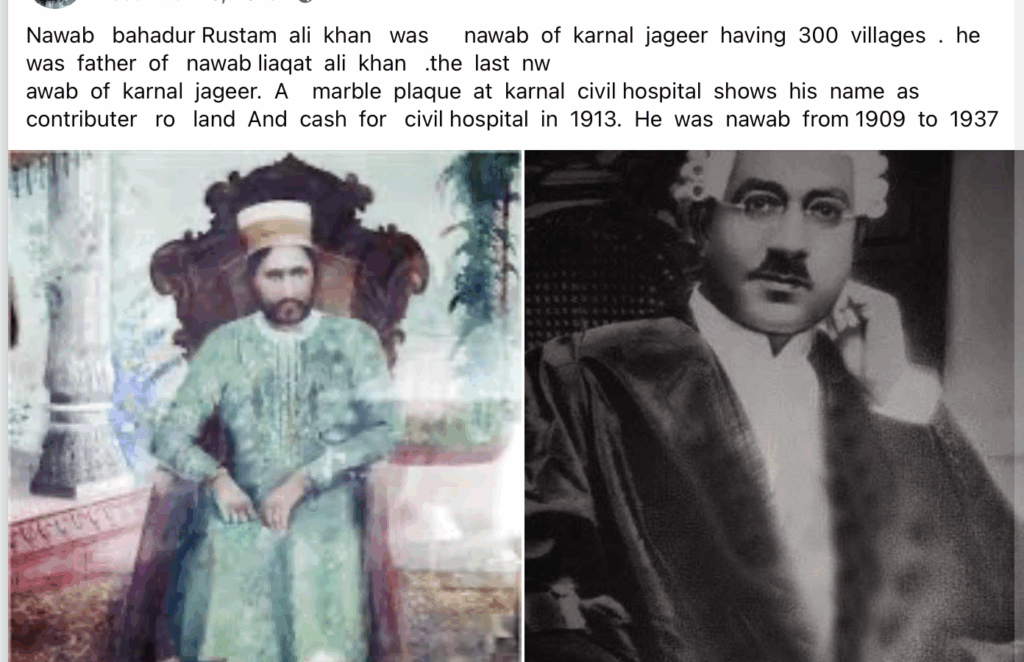
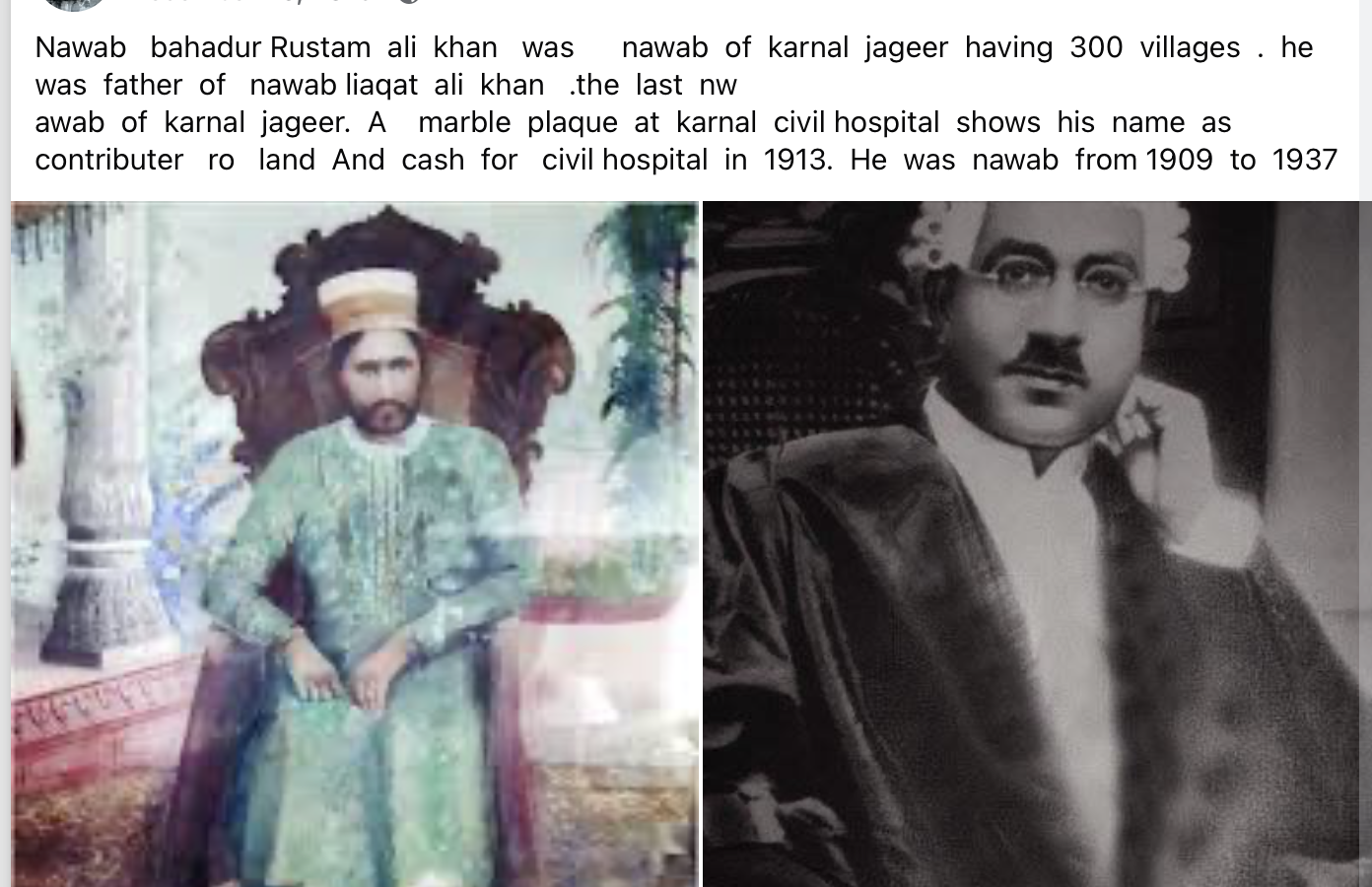
Nawab Rustam Ali Khan came to be known for his philanthropy, especially for his grants to the Muslim University, Aligarh. Liaquat’s ancestors suffered a setback during the 1857 uprising when the autonomous status of Karnal was rescinded and only the titles and part of the estates were left to them. It was this adversity suffered by the family. The Commissioner of Ambala Division, Mr Alma Latifi had quarrelled with Nawab Bahadur [Nawab Sajjad Ali Khan, Liaquat’s Bahadur’ elder brother]. He reported to the Government that ‘Nawab , who styled himself as the Nawab of Karnal, is not entitled to do so since this is the prerogative of the rulers of the princely states. He should call himself only as Nawab Sajjad Ali Khan Bahadur. Sir Malcolm Hailey, Governor of the Punjab, ruled that though it was unseemly on the part of Alma Latif to quarrel with the biggest zamindar of his circle, legally his point was well taken. Despite this reversal, Liaquat’s kinsmen continued to prosper and rise in prominence. Nawabzada Fayyaz Ali Khan (of Kanchpura), Nawab Mukhtar Ali Khan, and Nawab Umer Daraz Khan (Liaquat’s father-in-law) were Honorary Magistrates, while Nawabzada Wilayat Ali Khan and Nawabzada Nemat Ali Khan were Municipal Commissioners.® Pre-eminent among all these notables was Nawab Rustam Ali Khan, Liaquat Ali Khan’s father, whose wealth and standing had become proverbial in Karnal? We do not know much about Rustam Ali Khan beyond the general impression that he was religious, enlightened and philanthropic. We do have a more life-like portrait of his son and heir Nawab Sajjad Ali Khan, Liaquat’s elder brother. Rahm Ali Hashmi, Liaquat’s private secretary, writes with warmth and regard of Nawab Sajjad Ali Khan, his munificence, his love for Urdu poetry and his impressive knowledge of Persian literature, an accomplishment he shared with his young brother. Hashmi is less effusive about his employer but is not critical and acknowledges that Liaquat Ali Khan treated him with consideration and generosity.
The few references to Liaquat Ali Khan are more intimate than those found in formal biographies. Liaquat was a remarkably precocious and hardy child۔ Speaking to a reporter about his childhood only four days after his assassination, his mother Mehmuda Begum recalled: No, he was not mischievous generally, maybe once in a while — and his father never beat him. He was so gentle he could not beat him at all. Of course, I was stern with him at times specially when he made demands for too much money…but beat him. no.
From this and other interviews granted by Mehmuda Begum, “we gather that the wealth, the affluence and the grandeur surrounding him had a refining but not a softening effect on
Liaquat Ali Khan. This was because both his parents were deeply religious and imparted to their children their lofty ideals. Two of the anecdotes about Liaquat’s childhood relate to the holy months of Ramadan and Muharram. Liaquat was only four when he decided to fast in Ramadan. His mother told him that he was too young and that the fast was not obligatory for him. Liaquat kept silent but conspired with a servant who brought him the Sehri. When his mother called Liaquat for breakfast, he proudly announced he was fasting. He broke his fast at the appointed hour with his elders and fasted for a number of days that month.
Once, in the month of Muharram, after seeing a Tazia procession he gathered his friends together and made his own Tazia and recited elegies and dirges with such feeling that his
mother and other ladies of the household were moved to tears. Both these incidents point not only to deep religious feelings but to a willpower remarkable in one so young. His mother recounts that Liaquat was very gentle and kind to the servants and never treated them harshly. But inspite of this trait in his nature, he was after all a child and could be willful and obstinate on occasion. Once he took fancy to a silk sherwani and refused to touch any food until one was hastily tailored for him. Liaquat was also fond of holding court. He would allot
portfolios to his friends, and even in this humour he would listen to mock complaints and order the concerned ‘minister’ to redress them. For schooling, Liaquat’s father decided to send him to Aligarh. Once in Aligarh, Liaquat began to distinguish himself. According to the 1911 Aligarh Calendar, edited by Di Ziauddin Ahmed, Liaquat was then in Class VI of the MAO Collegiate
School, He was the monitor of his class and captain of the cricket team of his hostel, English House, having secured a double promotion earlier.
The double promotion came to him in a slightly dramatic fashion. He was to be awarded a book for coming first, but he caused a sensation by refusing to accept the prize. Upon
being called to explain his extraordinary conduct, Liaquat said that he could purchase any number of books but would accept the prize if a double promotion went with it. This, somehow,
created a favorable impression on the Inspector of Schools who, presiding over the ceremony, accepted Liaquat’s condition. Liaquat was very thin when he first went to Aligarh, but
in spite of his sporting activities he began to put on weight. It was also during his college days that his interests began to broaden. While vacationing in Karnal, he took lessons in music. He had a melodious voice and learnt the art of singing from Allah Bakhsh Mirasi. A Bengali musician named Hem Chandra gave him piano lessons.” He also played chess and other indoor games.